
Nusrat Jung
Tagline:Assistant Professor at Purdue University
West Lafayette, Indiana, USA
About Me
I am a faculty member in the Lyles School of Civil and Construction Engineering and hold a courtesy appointment in the School of Sustainability Engineering and Environmental Engineering at Purdue University. My research focuses on indoor air quality, airborne chemical exposures, and the development of real-time sensing platforms to evaluate the emissions from buildings, materials, and human activities.
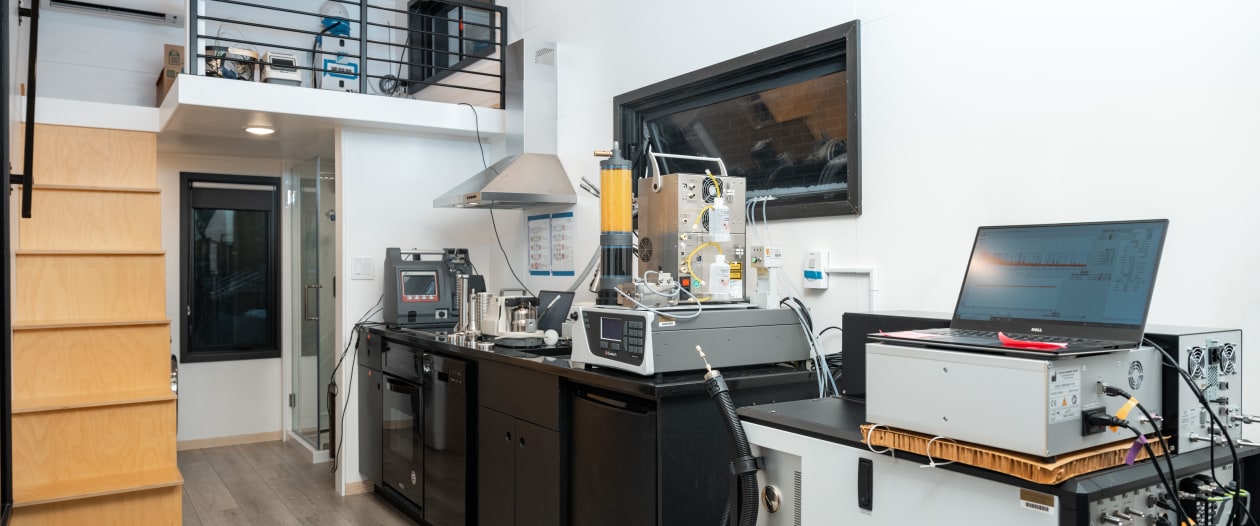
I lead a research group integrating building science, sensor development, and field experimentation to generate high-resolution data on ultrafine particles and volatile organic compounds. I am the lead developer of the zEDGE Test House - a reconfigurable smart building that I designed and built with my students. This platform supports field-based investigations of HVAC systems, ventilation strategies, and exposure mitigation. I also designed and implemented Purdue’s ASHRAE 52.2 filter testing rig, which is now used to evaluate particle filtration performance under controlled, applied conditions. These infrastructures were purpose-built to support experimental studies at scale, and several significant technical discoveries have emerged directly from this lab.
Clean indoor air is a foundational aspect of building performance and public health. While most people spend most of their lives indoors, indoor air quality remains under-measured and poorly understood. My work addresses this gap by providing actionable, time-resolved data that informs ventilation design, filtration strategies, and systems engineering across homes, schools, and workplaces.
I hold a Doctor of Science in Mechanical Engineering from Aalto University in Finland. At Purdue, I mentor undergraduate and graduate students through hands-on research involving advanced instrumentation, data interpretation, and system-level evaluation. This work has been recognized through multiple honors, including the Ross Judson Buck Outstanding Counselor Award (2023), the Harold Munson Outstanding Teacher Award (2025), the Mary Ann Zimmerman Purdue Civil Engineering Innovation Award (2025), and an NSF CAREER Award (2026).
I am also active in the professional community shaping indoor air quality practice and standards, serving as Treasurer-Elect on the Board of Directors of the International Society of Indoor Air Quality and Climate (ISIAQ), as a co-author of ASHRAE Standard 228-2023, and on the editorial boards of Indoor Environments (Elsevier) and Discover Atmosphere (Springer Nature).
Education
D.Sc.
from: 2012, until: 2018Field of study:Mechanical Engineering School:Aalto University Location:Espoo, Finland
DescriptionAcademy of Finland Fellowship
Research Interests
- Indoor Air Quality
- VOC and Particle Emissions
- Real-Time Air Monitoring
- Indoor Exposure Science
- Ventilation and Energy Efficiency
- Full-Scale Test Chambers
- Sensor-Based Building Diagnostics
Publications
Assessing Building-Integrated Bioremediation Infrastructure within the Context of Unsustainable Rising Atmospheric CO2
Journal ArticlePublisher:Energy and BuildingsDate:2026Authors:Phoebe Mankiewicz LedinsChristina CiardulloChunxu HuangPatrick PeaseTian MaRebecca RubrightCharlotte WelchMichelle BellNusrat JungKrystal Godri PollittElizabeth HenaffAnna DysonAdvancing Experiential Learning in Architectural Engineering through the Purdue zEDGE Test House: A Case Study in Hands-On Building Science Education
Journal ArticlePublisher:Journal of Architectural EngineeringDate:2026Authors:Nusrat JungMotasem QadanAditya ManeXiaosu DingReno SarussiReal-Time Characterization of Airborne Nanoparticle and Volatile Organic Compound Emissions from Dry Shampoo Products in a Residential Test House
Journal ArticlePublisher:Journal of Hazardous Materials LettersDate:2026Authors:Jordan CrossJianghui LiuChunxu HuangRashmika ManipatiNusrat JungIndoor Atmospheric Nanoparticle Emissions, Inhalation Exposures, and Indoor-to-Outdoor Transport during Residential Activities with Electric and Combustion Appliances
Journal ArticlePublisher:Journal of Hazardous MaterialsDate:2026Authors:Satya PatraChunxu HuangBrian MagnusonBrandon BoorNusrat JungReal-Time Evaluation of Energy Consumption and Indoor Environmental Quality in the Purdue zEDGE Tiny House
Journal ArticlePublisher:Science and Technology for the Built EnvironmentDate:2026Authors:Emmanuel AghimienHongbo LuXiaosu DingChunxu HuangJordan CrossNusrat JungNear-Real-Time Characterization of Indoor-Relevant Monoterpenes and Monoterpenoids Using fastGC-PTR-TOF-MS
Journal ArticlePublisher:Atmospheric EnvironmentDate:2026Authors:Jinglin JiangNusrat JungSpatiotemporal Variations in Ozone and Carbon Dioxide Concentrations in a HVAC System of a LEED-Certified Office Building
Journal ArticlePublisher:Building and Environment Date:2025Authors:Jinglin JiangJunkai HuangNusrat Jung Brandon BoorA Novel Methodology for Rapid Aging of HVAC Filters Using a Synthetic Submicron Aerosol: Effects of HVAC System Operational and Environmental Conditions on Filter Loading
Journal ArticlePublisher:Building and Environment Date:2025Authors:Chunxu HuangNusrat JungBrandon BoorDescription:2025 Best Paper Award for a Young Author from Building & Environment
Indoor Nanoparticle Emissions and Exposures during Heat-Based Hair Styling Activities
Journal ArticlePublisher:Environmental Science & TechnologyDate:2025Authors:Jianghui LiuJinglin JiangSatya PatraXiaosu DingChunxu HuangJordan CrossBrian MagnusonNusrat JungPeracetic Acid Emissions and Exposures During Building Disinfection Events
Journal ArticlePublisher:Building and EnvironmentDate:2025Authors:Xiaosu Ding Jinglin JiangAmisha ShahNusrat JungSpatiotemporal Mapping of Ultrafine Particle Fluxes in an Office HVAC System with a Diffusion Charger Sensor Array
Journal ArticlePublisher:ACS ES&T AirDate:2025Authors:Danielle WagnerNusrat JungBrandon BoorFlame-Free Candles are Not Pollution-Free: Scented Wax Melts as a Significant Source of Atmospheric Nanoparticles
Journal ArticlePublisher:Environmental Science & Technology LettersDate:2025Authors:Satya PatraJinglin JiangJianghui LiuGerhard SteinerNusrat Jung Brandon BoorRelease of Bisphenol A and Other Volatile Chemicals from New Epoxy Drinking Water Pipe Liners: The Role of Manufacturing Conditions
Journal ArticlePublisher:Environmental Science & TechnologyDate:2025Authors:Pritee PahariSamuel SpearsJianghui LiuSydney ButlerShantanu SonowaneAnthony GarciaMadeline LarsenCaitlin ProctorJohn HowarterJeffery YoungbloodNusrat JungAndrew WheltonDynamics of Nanocluster Aerosol in the Indoor Atmosphere During Gas Cooking
Journal ArticlePublisher:PNAS NexusDate:2024Authors:Satya S PatraJinglin JiangXiaosu DingChunxu HuangEmily ReidyVinay KumarPaige PriceConnor KeechGerhard SteinerPhilip StevensNusrat JungBrandon BoorModern Buildings Act as a Dynamic Source and Sink for Urban Air Pollutants
Journal ArticlePublisher:Cell Reports SustainabilityDate:2024Authors:Tianren WuAntonios TasoglouDanielle WagnerJinglin JiangHeinz HuberPhilip StevensNusrat Jung Brandon BoorReal-Time Evaluation of Terpene Emissions and Exposures during the Use of Scented Wax Products in Residential Buildings with PTR-TOF-MS
Journal ArticlePublisher:Building and EnvironmentDate:2024Authors:Jianghui LiuJinglin JiangXiaosu DingSatya PatraJordan CrossChunxu HuangVinay KumarPaige PriceEmily ReidyAntonios TasoglouHeinz HuberPhilip StevensBrandon Boor Nusrat JungThe Influence of Displacement Ventilation on Indoor Carbon Dioxide Exposure and Ventilation Efficiency in a Living Laboratory Open-Plan Office
Journal ArticlePublisher:Building and EnvironmentDate:2024Authors:Yalin LuJunkai HuangDanielle WagnerZhang LinNusrat JungBrandon BoorRapid Nucleation and Growth of Indoor Atmospheric Nanocluster Aerosol during the Use of Scented Volatile Chemical Products in Residential Buildings
Journal ArticlePublisher:ACS ES&T AirDate:2024Authors:Satya PatraJianghui LiuJinglin JiangXiaosu DingChunxu HuangConnor KeechGerhard SteinerPhilip StevensNusrat JungBrandon BoorDescription:2024 Best Paper Award from ACS ES&T Air
Rapid Screening of Volatile Chemicals in Surface Water Samples from the East Palestine, Ohio Chemical Disaster Site with Proton Transfer Reaction Mass Spectrometry
Journal ArticlePublisher:Science of the Total EnvironmentDate:2024Authors:Jinglin Jiang Xiaosu DingPaula CoelhoGrayson WittbrodAndrew WheltonBrandon BoorNusrat JungImpact of Curing Temperature on the Life Cycle Assessment of Sugarcane Bagasse Ash as a Partial Replacement of Cement in Mortars
Journal ArticlePublisher:SustainabilityDate:2023Authors:Vito FranciosoMarina Lopez-AriasCarlos MoroNusrat JungMirian Velay-LizancosReal-Time Indoor Sensing of Volatile Organic Compounds during Building Disinfection Events via Photoionization Detection and Proton Transfer Reaction Mass Spectrometry
Journal ArticlePublisher:Building and EnvironmentDate:2023Authors:Xiaosu DingHongbo LuJinglin JiangAntonios TasoglouAmisha ShahNusrat JungEvaluation of Workplace Exposures to Volatile Chemicals During COVID-19 Building Disinfection Activities with Proton Transfer Reaction Mass Spectrometry
Journal ArticlePublisher:Annals of Work Exposures and HealthDate:2023Authors:Xiaosu DingJinglin JiangAntonios TasoglouHeinz HuberAmisha ShahNusrat JungSiloxane Emissions and Exposures during the Use of Hair Care Products in Buildings
Journal ArticlePublisher:Environmental Science & TechnologyDate:2023Authors:Jinglin JiangXiaosu DingSatya PatraJordan CrossChunxu HuangVinay KumarPaige PriceEmily ReidyAntonios TasoglouHeinz HuberPhilip StevensBrandon BoorNusrat JungEthanol-Based Disinfectant Sprays Drive Rapid Changes in the Chemical Composition of Indoor Air in Residential Buildings
Journal ArticlePublisher:Journal of Hazardous Materials LettersDate:2021Authors:Jinglin JiangXiaosu DingKristofer IsaacsonAntonios TasoglouHeinz HuberAmisha ShahNusrat JungBrandon BoorReal-Time Measurements of Botanical Disinfectant Emissions, Transformations, And Multiphase Inhalation Exposures In Buildings
Journal ArticlePublisher:Environmental Science & Technology LettersDate:2021Authors:Jinglin JiangXiaosu DingAntonios TasoglouHeinz HuberAmisha ShahNusrat JungBrandon BoorUsing Building Energy and Smart Thermostat Data to Evaluate Indoor Ultrafine Particle Source and Loss Processes in a Net-Zero Energy House
Journal ArticlePublisher:ACS ES&T EngineeringDate:2021Authors:Jinglin JiangNusrat JungBrandon BoorTowards Circular Cities—Conceptualizing Core Aspects
Journal ArticlePublisher:Sustainable Cities & Society Date:2020Authors:Satu PaihoElina MakiNina WessbergMartta PaavolaPekka TuominenMaria AntikainenJouko HeikkilaCarmen Antuna RozadoNusrat JungDrivers and Benefits for District-Scale Energy Refurbishment
Journal ArticlePublisher:CitiesDate:2019Authors:Tarja HäkkinenMia Ala-JuuselaTarja MäkeläinenNusrat JungImpact of Renewable Energy Technologies on the Embodied and Operational GHG Emissions of a Nearly Zero Energy Building
Journal ArticlePublisher:Journal of Building EngineeringDate:2019Authors:Sirje VaresTarja HäkkinenJaakko KetomäkiJari ShemeikkaNusrat JungExtending Capabilities of BIM to Support Performance Based Design
Journal ArticlePublisher:Journal of Information Technology in Construction: ITconDate:2018Authors:Nusrat JungTarja HäkkinenMirkka RekolaEnergy Performance Analysis of an Office Building in Three Climate Zones
Journal ArticlePublisher:Energy and BuildingsDate:2018Authors:Nusrat JungSatu PaihoJari ShemeikkaRisto LahdelmaMiimu AiraksinenSocial Acceptance of Renewable Energy Technologies for Buildings in the Helsinki Metropolitan Area of Finland
Journal ArticlePublisher:Renewable EnergyDate:2016Authors:Nusrat JungMunjur E MoulaTingting FangMohamed HamdyRisto LahdelmaReducing Embodied Carbon During the Design Process of Buildings
Journal ArticlePublisher:Journal of Building EngineeringDate:2015Authors:Tarja HäkkinenMatti KuittinenAntti RuuskaNusrat JungResearching Social Acceptability of Renewable Energy Technologies in Finland
Journal ArticlePublisher:International Journal of Sustainable Built EnvironmentDate:2013Authors:Md Munjur E MoulaJohanna MaulaMohamed HamdyTingting FangNusrat JungRisto Lahdelma
Professional Contact
Address
Purdue University
Lyles School of Civil and Construction Engineering
550 Stadium Mall Drive
West Lafayette, IN 47907-2051
United States of America
Teaching
EPICS: Global Air Quality Trekkers (GAQT)
From: 2023, Until: present
Organization:Purdue UniveristyField:Engineering Projects in Community Service
Description:Description: EPICS Global Air Quality Trekkers (GAQT), led by Dr. Nusrat Jung, is a pioneering initiative dedicated to addressing global air quality challenges by transforming how we monitor and mitigate indoor air pollution. Our mission is to create healthier environments in homes, schools, and workplaces by leveraging cutting-edge technologies and innovative solutions.
Indoor air pollution - caused by toxic chemicals in building materials, furnishings, cleaning products, and outdoor contaminants - poses severe health risks. It is a silent but significant threat linked to respiratory illnesses, asthma, reduced lung function, and chronic pulmonary diseases. Children are especially vulnerable, facing heightened risks that lead to increased absenteeism, reduced academic performance, and long-term health consequences. GAQT is committed to creating transformative change by implementing state-of-the-art air quality sensing networks and next-generation filtration systems, paving the way for cleaner, healthier communities worldwide.
CE 31101: Architectural Engineering
From: 2019, Until: present
Organization:Purdue UniveristyField:Architectural Engineering
Description:Course Objectives
This course’s objective is to introduce the engineering fundamentals required for the design and analysis of building environmental systems, such as thermodynamics and psychrometrics, fluid mechanics, heat transfer, and mass transfer. It also presents engineering principles and selected applications related to hygrothermal analysis of building enclosures, air conditioning processes, ventilation, and indoor air quality.Learning Outcomes
Upon completion of this course, the students will be able to:- Demonstrate knowledge of thermodynamics and psychrometrics; fluid mechanics; heat transfer via conduction, convection, and radiation; and mass/moisture transfer for use in building design.
- Identify and analyze the characteristics of building environmental loads, building construction, and building operations as they define the requirements for a comfortable and healthy indoor environment.
- Identify, formulate, and solve realistic Architectural Engineering problems related to hygrothermal analysis of building enclosures, air conditioning processes, and ventilation.
- Demonstrate an understanding of building systems integration to achieve efficient operation.
The learning process includes:
- Reading: The textbook is a comprehensive source of information on fundamental thermal science topics. Readings on green building technologies will engage you with industry applications.
- Lectures: supplement fundamental concepts from the readings. In-classroom example problems will emphasize applying these concepts to the analysis of heating, ventilation, and air conditioning (HVAC) systems and building enclosures.
- Homework Assignments: designed to reinforce the concepts presented during lectures. Students shall become familiar with analytical and computational methods for quantifying building performance.
- ArchE Lab Modules: Students will work as teams to evaluate various features of the new Purdue zero Energy Design Guidance for Engineers (zEDGE) Tiny House, evaluate the thermal conductivity of materials using new equipment, conduct experiments to understand the psychrometric process using the HVAC system in the HAMP G159 laboratory, etc.
CE 51901: BIM for High Performance Buildings
From: 2019, Until: present
Organization:Purdue UniveristyField:Architectural Engineering
Description:Course Objectives
The objectives of this course are: (1.) to introduce fundamental concepts of architectural engineering design to develop a deeper understanding of what constitutes our built environment; (2.) future of designing buildings: introduction to Building Information Modeling (BIM), BIM as a process, benefits and problems with a focus on interoperability and building performance-based simulations; (3.) to learn how to apply architectural engineering design and BIM principles towards obtaining high-performance buildings.Course Outcomes
Upon completion of this course, students will be able to:- Understand architectural engineering design principles and their impact on the choice of building systems, such as form, space, organization, circulation, proportion, and scale.
- Apply knowledge of BIM concepts and applications, BIM software (REVIT), and usage of BIM tools in architectural engineering.
- Identify how BIM can support and improve multi-criteria assessment of high-performance buildings.
- Evaluate the interoperability between the BIM-based model and Building Performance Simulations (BPS).
- Become conversant with the language used by architects and BIM modelers to enhance collaboration and improve technical communication within large project teams in industry.
The learning process includes:
- Readings: The textbook is a comprehensive source of information on fundamental BIM topics and applications. Selected readings from the peer-reviewed literature on architectural engineering design, BIM, and building performance simulations (energy and environmental issues) will engage you with leading academic research and industry applications.
- Lectures and Computer lab sessions: supplement fundamental concepts from the readings. In-classroom examples will emphasize applications of architectural design, BIM, and high-performance building concepts in architectural engineering.
- Homework Assignments: designed to reinforce the concepts presented during lectures. Students shall become familiar with parametric design methods (utilizing REVIT) and technical writing.
- Course Project: Students can connect course concepts with a building-related topic of their interest (e.g., tied to their M.S. or Ph.D. research).
Graduate Student Supervision
- KS
Kamlendra Singh Pathak
Indoor Air Quality Research
date: 2026 - presentDegree: Doctoral Degree .University: Purdue University .Department: Lyles School of Civil and Construction Engineering .
- RC
Rivan Chandra Roy
Indoor Air Quality Research
date: 2026 - presentDegree: Doctoral Degree .University: Purdue University .Department: Lyles School of Civil and Construction Engineering .
- JL
Joowon Lee
Real-Time Detection and Characterization of Bioaerosols in Aseptic Environments
date: 2025 - presentDegree: Doctoral Degree .University: Purdue University .Department: Lyles School of Civil and Construction Engineering .
- JC
Jordan Cross
Volatile Chemical Emissions in Indoor Environments: Sources, Sensory Perception, and Implications for Human Exposure
date: 2023 - presentDegree: Doctoral Degree .University: Purdue University .Department: Lyles School of Civil and Construction Engineering .
- J(
Jianghui (Rebecca) Liu
Sources and Dynamics of Volatile Chemicals in Residential Settings: Impacts of Scented Consumer Product Use on Indoor Air
date: 2022 - 2026Degree: Doctoral Degree .University: Purdue University .Department: Lyles School of Civil and Construction Engineering .
- HL
Hongbo Lu
Real-Time Energy and Indoor Environmental Quality Monitoring of a Compact Living Space
date: 2022 - 2024Degree: Master's Degree .University: Purdue University .Department: Lyles School of Civil and Construction Engineering .
- JC
Jordan Cross
Coupling an Olfaction Chamber with Proton Transfer Reaction Mass Spectrometry for Evaluating Human Response to Scented Volatile Chemical Product Emissions
date: 2021 - 2023Degree: Master's Degree .University: Purdue University .Department: Lyles School of Civil and Construction Engineering .
- JJ
Jinglin Jiang
How Human Activities and Ventilation Systems Impact Indoor Air Composition and Chemistry in Buildings
date: 2019 - 2024Degree: Doctoral Degree .University: Purdue University .Department: Lyles School of Civil and Construction Engineering .
- XD
Xiaosu Ding
Real-Time Evaluation of Volatile Chemical Emissions and Exposures During Disinfection Process in Buildings
date: 2019 - 2024Degree: Doctoral Degree .University: Purdue University .Department: Lyles School of Civil and Construction Engineering .
- MV
Mikko Virta
Energy Efficient Optimization of Multiple Buildings
date: 2014 - 2015Degree: Master's Degree .University: Aalto University .Department: Mechanical Engineering .
Editorial Roles
Image Gallery
A visual summary of our field-based research infrastructure, advanced instrumentation, and student-led experimental work on indoor air quality, filtration, and system performance.